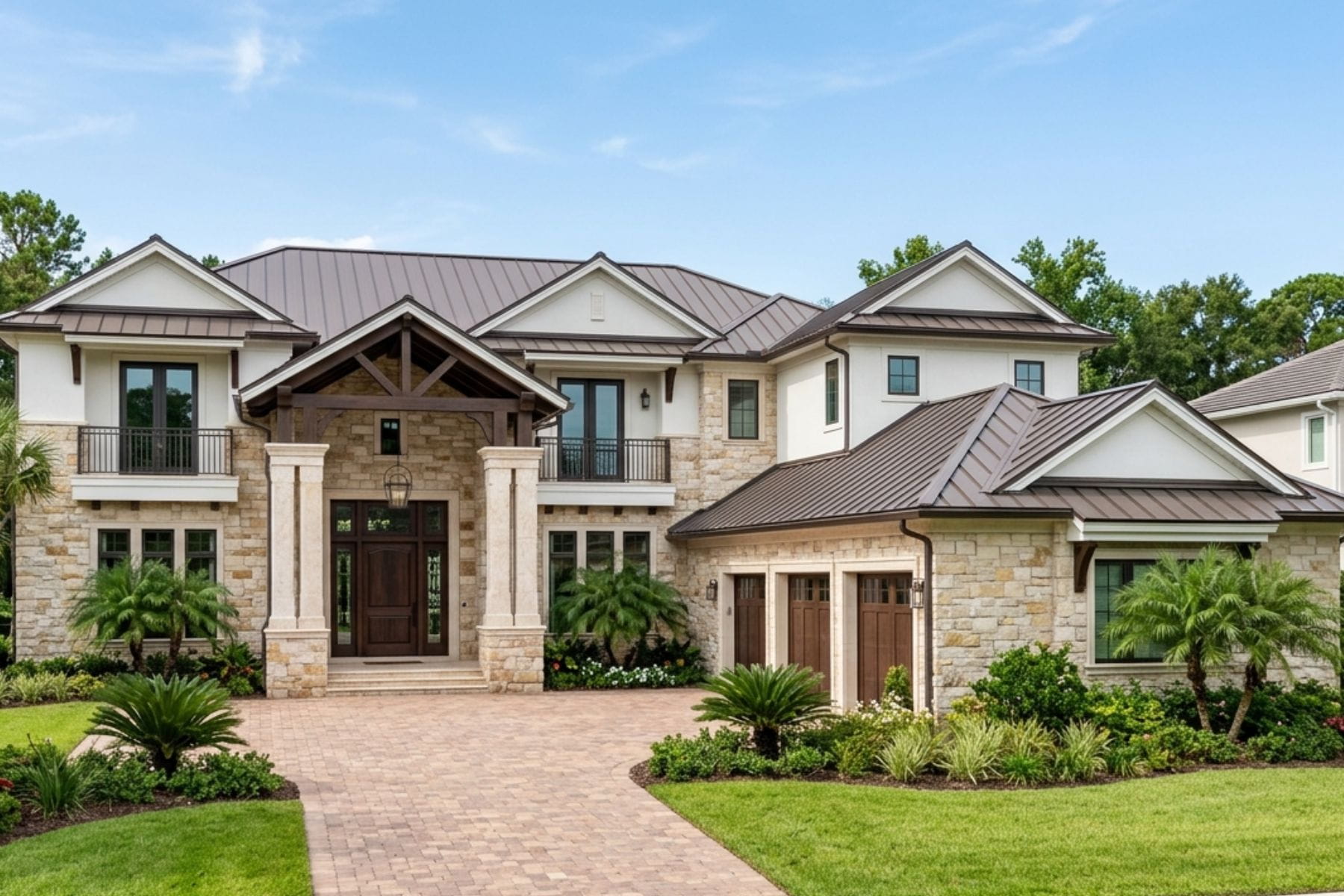
Jacksonville Stone Installation
Jacksonville’s Stone Masonry Specialists — Natural, Cultured, and Veneer Stone for the First Coast
Stone installation in Northeast Florida isn’t the same job it is in the mountain states or the Southwest. Our humidity, salt air, temperature swings, and wind-driven rain create a set of performance requirements that govern every material choice and installation detail. First Coast Masonry has installed stone across the First Coast for residential and commercial clients who wanted the look and durability of masonry without shortcuts that fail in our climate.
We work with natural stone quarried from across the country and the Caribbean, domestic and imported cultured stone products, and thin-veneer systems that bring masonry aesthetics to projects where full-depth stone isn’t structurally or logistically practical.
How to Choose the Right Stone for Jacksonville Projects
Natural Stone
Natural stone — quarried directly from the earth, cut and finished — is the premium end of the stone installation market. It’s heavier, requires more structural support, and demands more skilled installation than cultured stone, but it delivers a visual depth and authenticity that manufactured products replicate only approximately.
Limestone — A Florida native material. Coquina, the shell-based limestone used in historic St. Augustine construction, is a reminder that stone construction on the First Coast goes back to the 1600s. Modern limestone installation uses quarried stone from Florida, Georgia, and Indiana. Limestone is porous and requires sealing in our environment.
Marble — Used primarily in interior applications — flooring, fireplace surrounds, accent walls. Outdoor marble in Florida’s acidic rain environment requires careful sealing and periodic maintenance.
Granite — Extremely durable, low-porosity, and well-suited to Florida’s outdoor conditions. Used on countertops, steps, copings, and accent features. Granite holds up to salt air better than most stones.
Fieldstone and River Rock — Irregular natural stones used in garden walls, water features, and rustic accent applications. Sourced from regional quarries and river deposits.
Travertine — Popular for pool decks and patio surfaces throughout Florida. The honed and filled version provides a non-slip surface. Requires appropriate grout and sealant for outdoor wet environments.
Cultured Stone and Manufactured Veneer
Cultured stone is a concrete-based manufactured product cast in molds taken from actual natural stone faces. Quality has improved dramatically over the past decade — well-installed cultured stone is difficult to distinguish from natural stone at normal viewing distances.
Advantages for Florida installation:
- Lighter weight (typically 10-15 lbs per square foot vs. 25-50 lbs for natural veneer) reduces structural load demands
- Consistent dimensional tolerances simplify installation
- Lower material cost makes larger coverage areas economically feasible
- Many manufacturers produce products specifically tested for moisture resistance
We install products from Eldorado Stone, Belgard, and other manufacturers with documented Florida performance data. Not all cultured stone performs equally in high-humidity environments — we specify products with appropriate moisture resistance ratings.
Stone Veneer Systems
Stone veneer — whether natural thin veneer (typically 1-1.5 inches thick) or cultured veneer — is installed over a prepared substrate rather than built as a structural mass. In Florida, the substrate preparation is where the performance equation is won or lost:
On CMU block or concrete: A scratch coat of polymer-modified mortar creates the bonding surface. Moisture resistance of the substrate is critical.
On wood-framed walls: A drainage mat, two layers of Grade D building paper or appropriate WRB (weather-resistant barrier), and metal lath are required before any mortar or stone is applied. This drainage plane is essential — Florida’s wind-driven rain will find its way behind stone veneer, and it must have a path out.
We follow MVMA (Masonry Veneer Manufacturers Association) installation guidelines and applicable FBC provisions for all veneer work.
Indoor Stone Applications
Inside Jacksonville homes and commercial spaces, stone adds warmth, texture, and visual weight that paint, drywall, and most other finish materials can’t replicate.
Fireplace Surrounds and Hearths — One of the most requested indoor stone applications. Full stone fireplace surrounds, from firebox to ceiling, transform a room. We work with both prefab fireplace units (adding stone facing around the frame) and masonry fireplaces (where the stone is part of the structural assembly).
Feature Walls — Stone accent walls in living rooms, dining rooms, entryways, and hotel lobbies. Cultured veneer is the most common material here — lighter weight reduces structural concerns with interior wood-framed walls.
Kitchen Islands and Backsplashes — Natural stone on kitchen islands (requiring appropriate substrate and countertop edge work) and stone tile or slab backsplashes.
Flooring — Travertine, limestone, marble, and slate flooring in residential and commercial spaces. Floor applications require appropriate underlayment, grout selection, and sealing.
Bathroom Shower Surrounds — Stone in wet applications requires meticulous waterproofing of the substrate — cement board, appropriate membrane systems, and grout specified for wet environments.
Outdoor Stone Applications in Jacksonville
Northeast Florida’s outdoor living culture — long warm seasons, outdoor kitchens, covered lanais, pool decks — creates significant demand for exterior stone work.
Exterior Accent Walls — Stone on home facades, garage walls, and commercial building entries. The drainage plane detailing described above is non-negotiable for Florida outdoor stone.
Steps and Walkways — Bluestone, travertine, and limestone are common choices for exterior steps and walkways. Non-slip surface texture matters in our rain-heavy climate.
Pool Deck Coping and Surrounds — Travertine and limestone copings around pools are a First Coast staple. These require slip-resistant surface treatment and are subject to pool chemistry exposure — proper sealing extends service life dramatically.
Retaining Wall Facing — Stone facing on concrete or CMU retaining walls provides a natural aesthetic while the structural wall handles the lateral earth loads.
Outdoor Fireplace and Kitchen Stone — Stone facing on outdoor fireplace structures and outdoor kitchen islands. These applications see direct weather exposure and require appropriately specified stone and mortar.
Coastal Considerations for Stone Installation
Properties within a mile or two of the Atlantic coast, the Intracoastal Waterway, or the St. Johns River mouth face an accelerated weathering environment that affects material selection:
Salt Spray Exposure — Chloride deposition attacks mortar joints and some stone types. We specify mortar products with sulfate resistance ratings appropriate for coastal exposure.
Moisture Cycling — The daily temperature and humidity fluctuations in coastal zones create more expansion and contraction in stone installations than inland sites. We use appropriate joint widths and polymer-modified mortars that flex with movement.
Stone Selection — Dense, low-porosity stones (granite, dense limestone) perform better in salt-air environments than porous stones (soft limestone, sandstone). We discuss performance tradeoffs with clients before specifying materials on coastal projects.
Sealer Selection — Penetrating silane/siloxane sealers that allow moisture vapor transmission while reducing liquid water absorption are our standard specification for outdoor stone in Jacksonville. Film-forming sealers trap moisture and accelerate spalling.
Jacksonville Stone Installation Services — What’s Included
1. Consultation and Material Selection — We meet on-site, discuss the application and aesthetic goals, and present material options appropriate for the specific project environment. Samples are reviewed before ordering.
2. Substrate Assessment — For existing walls receiving stone veneer, we evaluate the substrate condition. Failed substrates must be repaired before stone work begins.
3. Substrate Preparation — Weather-resistant barrier, lath, and scratch coat application as required by the substrate type and stone system specifications.
4. Layout and Pattern Planning — Stone coursing and pattern are laid out before installation begins. For natural stone with significant size and shape variation, a dry-layout on the ground lets us optimize placement before committing to mortar.
5. Setting and Pointing — Stone is set in mortar following manufacturer and MVMA guidelines. Joints are pointed and finished to the specified profile after setting mortar has achieved initial cure.
6. Cleaning and Sealing — Final surface cleaning removes mortar smear and efflorescence. Sealer is applied per manufacturer instructions, typically after a full 28-day cure period.
Jacksonville Stone Contractors — Areas We Serve
We install stone throughout Jacksonville and the surrounding First Coast region:
- Jacksonville (all neighborhoods and zones)
- Jacksonville Beach, Neptune Beach, Atlantic Beach — salt-air specifications standard
- Ponte Vedra Beach and South Ponte Vedra — residential estate and coastal commercial
- Orange Park, Fleming Island — Clay County residential and commercial
- Fernandina Beach, Amelia Island — coastal residential and hospitality projects
- St. Augustine and St. Johns County — historic district compliance available for restoration work
- Nocatee and Palm Valley — new construction and renovation
Frequently Asked Questions — Stone Installation Jacksonville
What types of stone do you install?
We install natural stone (limestone, granite, travertine, marble, fieldstone, bluestone), cultured stone from manufacturers including Eldorado Stone and Belgard, and thin natural stone veneer. Application guides our material recommendation — outdoor vs. indoor, wet vs. dry, structural vs. decorative, and Florida’s coastal vs. inland environment all factor into the right material for your project.
Is natural stone or cultured stone better for Florida?
It depends on the application and the specific products being compared. Natural granite and dense limestone perform exceptionally well outdoors in Florida’s climate. Soft natural stones like Indiana limestone require more maintenance in our acidic rain environment. High-quality cultured stone products formulated for moisture resistance perform well in most Florida applications and offer significant weight and cost advantages. We’ll give you an honest comparison for your specific project, not a blanket recommendation.
Can stone be installed on existing walls?
Yes, in most cases. Existing concrete or CMU walls in good condition are excellent substrates for stone veneer. Existing wood-framed walls can receive stone veneer with proper drainage mat and lath installation. The key is that the substrate must be structurally sound and capable of supporting the added weight. We assess existing walls before proposing installation scope.
How long does stone installation take?
A typical residential exterior accent wall — say, a home’s gable end or a garage face — takes two to five days for installation plus cure time before sealing. Interior fireplace surrounds generally take one to two days. Larger projects or natural stone with complex coursing patterns take proportionally longer. After the site assessment, we’ll give you a realistic timeline.
What is the difference between stone veneer and full-depth stone construction?
Full-depth stone construction uses stone as the structural material — think colonial stone houses or garden walls entirely built from stacked stone. Veneer is a facing material applied over a separate structural substrate (CMU block, wood frame, concrete). Full-depth stone is rare in new construction due to cost and structural engineering requirements. Most residential and light commercial stone work today uses veneer systems, which can achieve nearly identical aesthetics at lower cost and weight.
Get a Free Stone Installation Estimate
Stone done right elevates a First Coast property in ways that outlast any other exterior investment. First Coast Masonry brings the local knowledge, correct material specifications, and skilled installation to make it last.
Contact us to schedule a consultation. We’ll visit the site, review your goals, and provide a free written estimate with clear scope.