Jacksonville Pavers & Patios
Paver Driveways, Patios, and Pool Decks Built for First Coast Outdoor Living
The First Coast’s outdoor culture — long warm seasons, backyard entertaining, pool-centric lifestyles — makes paver surfaces one of the most commonly upgraded features on Jacksonville properties. A concrete slab works. A well-installed paver surface does something concrete can’t: it flexes with the seasonal movement endemic to Jacksonville’s sandy soils, handles Duval County’s stormwater requirements with permeable options, and looks significantly better doing it.
First Coast Masonry installs brick pavers, concrete pavers, and natural stone paving for driveways, patios, pool decks, walkways, and outdoor kitchen floors throughout Jacksonville and the First Coast. Our pavers Jacksonville homeowners rely on most are concrete pavers and travertine — both hold up well in Florida’s climate.
How to Choose Paver Types for Jacksonville Homes
Brick Pavers
Fired clay brick pavers are the classic choice — the original paver material, used in Jacksonville-area historic districts and still one of the most durable paving options available. True brick pavers (not concrete brick-look pavers) are typically 1-5/8 to 2-3/8 inches thick and set in sand or mortar over a prepared base.
Advantages of brick pavers in Florida:
- Exceptionally long service life — many First Coast streets still have original brick paving installed generations ago
- Natural color variation that ages gracefully rather than fading uniformly
- Can be lifted, cleaned, and reset if settling or utility work disturbs the base
- No sealing required (unlike concrete pavers, which benefit from periodic resealing)
The trade-off: brick pavers typically carry a higher material cost than concrete pavers.
Concrete Pavers
Concrete pavers are the most versatile and widely installed paving option on the First Coast. They’re produced in a far wider range of sizes, shapes, thicknesses, colors, and surface textures than brick, giving designers and homeowners extensive creative latitude.
For Jacksonville outdoor applications, look for concrete pavers with:
- Minimum 3,000 PSI compressive strength
- Low water absorption rate (important for Florida’s moisture environment)
- UV-stable pigmentation (Florida’s solar exposure fades lower-quality concrete pavers noticeably within a few years)
- Textured or tumbled surface finish for appropriate slip resistance on pool decks and wet areas
Concrete pavers require periodic sealing (typically every three to five years) to maintain color and protect against staining.
Natural Stone Pavers
Natural stone paving — travertine, limestone, bluestone, granite cobble — is used on premium residential projects and upscale commercial spaces throughout the First Coast.
Travertine is the dominant natural stone paver choice in Jacksonville, particularly for pool decks. Its matte, honed surface stays cool underfoot in direct sun better than dark concrete pavers, and it doesn’t get as slippery when wet as some alternatives. Florida travertine pool decks are common enough that the local stone supply chain is well-established.
Limestone gives a more formal, European-influenced aesthetic. Like travertine, it requires appropriate sealing against Florida’s acidic rain.
Granite cobble and setts are used for driveway borders, accent bands, and specialty hardscape applications where an extremely durable, dense stone is needed.
Jacksonville Patio Contractors — Driveways, Patios, Pool Decks
Paver Driveways
A paver driveway makes a permanent first impression on a First Coast home. Beyond aesthetics, paver driveways have practical advantages:
- Repairability — A cracked concrete driveway requires grinding or full replacement to address. Settled or cracked pavers can typically be lifted in the affected area, the base material regraded or added, and the pavers reset.
- Drainage management — Permeable paver systems or properly designed paver driveways with drainage channels direct stormwater appropriately.
- No expansion joint cracking — Concrete driveways eventually crack at or near expansion joints. Paver joints accommodate movement without the same visual deterioration.
Driveways require a properly engineered base — typically 8 inches of compacted crushed aggregate base material with a bedding sand layer — to support vehicle loads without settling.
Paver Patios
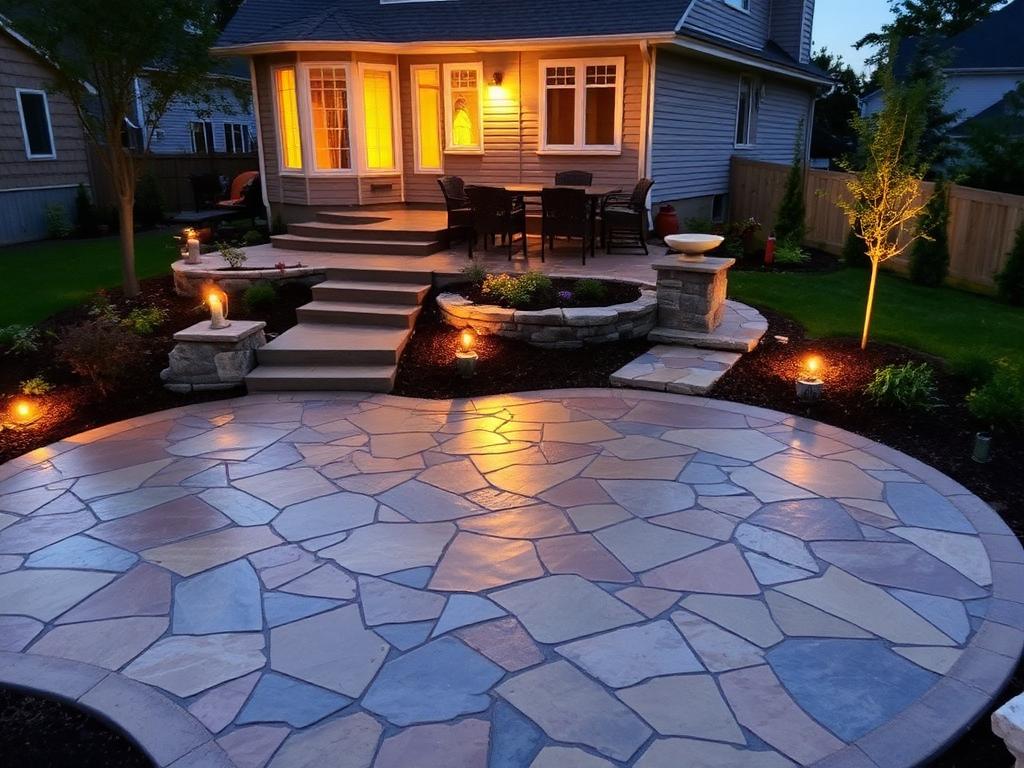
The paver patio is the foundation of the First Coast backyard. Around it: the outdoor kitchen, the fireplace, the furniture grouping, the pool edge. Getting the patio right — level, properly drained, appropriate for the intended foot traffic and furniture loads — makes everything built around it work better.
We design patio drainage slopes toward the yard or drainage channels, never toward the house foundation. In Jacksonville’s heavy rain events, an improperly pitched patio collects water against the foundation — a problem that compounds over years.
Pool Decks and Coping
Pool deck paving is among the most demanding paver applications in Jacksonville. The material must:
- Stay slip-resistant when wet
- Not get dangerously hot underfoot in direct sun
- Resist pool water chemistry (chlorine and pH fluctuations)
- Hold up to the expansion and contraction of a Florida outdoor environment
- Look good through heavy foot traffic from wet bathing suits and bare feet
Travertine and light-colored concrete pavers are the most commonly specified materials for First Coast pool decks. Pool coping — the cap stones at the pool edge — requires specific sizing and edge profiles appropriate for the pool system.
Walkways and Entry Approaches
Front walkways, side-yard paths, and garden walkways are where paver installation can add substantial curb appeal to a First Coast home at relatively modest scale. We handle everything from simple straight brick path installations to complex curved approaches with brick borders and contrasting field materials.
Permeable Pavers and Duval County Stormwater Rules
Jacksonville sits within a watershed that discharges to the St. Johns River — a water body that has faced significant environmental stress from stormwater nutrient loading. Duval County and the St. Johns River Water Management District (SJRWMD) have stormwater management requirements that apply to certain property improvements, including large paved areas.
Permeable (or pervious) pavers are a code-compliant and environmentally beneficial alternative to impervious paving for qualifying projects. Rather than shedding all rainfall to the storm drain system, permeable paver systems allow water to infiltrate through the joints and base material, recharging groundwater and reducing peak runoff.
How Permeable Paver Systems Work:
Water passes through wider-than-standard joints filled with clean angular aggregate (or through open-cell paver units) into a reservoir layer of crushed aggregate below the surface, where it slowly infiltrates into the subgrade. The reservoir is sized based on the design storm volume and the infiltration rate of the native soil.
When Permeable Pavers Are Appropriate:
- Properties in stormwater management plan areas
- Projects seeking LEED or Green Building credit
- Sites with limited storm drain connection options
- Driveways and parking areas where stormwater management is a primary design requirement
Note: permeable paver systems require periodic maintenance (vacuuming of joint aggregate) to maintain infiltration capacity. In Jacksonville’s tree canopy areas, organic debris can clog joints — we discuss maintenance requirements with every client before permeable paver specification.
Florida Durability — Why Paver Selection Matters Here
Florida’s environment is hard on exterior paving. Here’s what you need to know:
UV Exposure — Florida receives approximately 2,800 hours of sunlight annually. Lower-quality concrete pavers and sealers fade noticeably within three to five years. We specify products with documented UV stability ratings.
Freeze-Thaw — Minimal concern in Jacksonville (we average fewer than 5 nights below freezing per year), but occasional hard freezes do occur. Quality concrete pavers meeting ASTM C936 are rated for freeze-thaw cycling regardless.
Rain Volume — Jacksonville averages 52 inches of rainfall annually, much of it during intense summer thunderstorms. Proper base construction and drainage design are the critical performance variables for First Coast paver installations.
Hurricane Wind Events — Loose pavers in the path of hurricane-force winds can become projectiles. Driveways and patios near buildings are sometimes set in mortar rather than sand for wind-prone coastal locations — we discuss this with clients on oceanfront and exposed properties.
Jacksonville Paver Installation Services — Our Process
1. Site Assessment and Design — We evaluate the site, existing drainage patterns, intended use, and design preferences. On larger or more complex projects, a sketch layout is produced for review before work begins.
2. Excavation — The paving area is excavated to the required depth for the base material and paver thickness. Typical residential patio excavation is 8-10 inches; driveways require 10-12 inches.
3. Base Preparation — Crushed aggregate base material is placed in compacted lifts. A plate compactor is used to achieve appropriate density. This step is what separates a paver installation that holds its grade for 20 years from one that develops ruts and settled areas in five.
4. Edge Restraint Installation — Paver edge restraints (aluminum or plastic stake-and-rail systems) are installed around the perimeter. These prevent pavers from migrating outward over time.
5. Bedding Sand Layer — A 1-inch layer of coarse angular bedding sand is screeded to a consistent grade on top of the compacted base.
6. Paver Installation — Pavers are laid in the specified pattern, cut at borders with a masonry saw, and snapped or tamped into the bedding sand.
7. Joint Sand and Compaction — Polymeric joint sand is swept into the joints and activated with water. A final plate compactor pass seats the pavers and sets the joint sand.
8. Sealing — Concrete and natural stone pavers receive an appropriate sealer application after installation and an initial cure period.
First Coast Masonry is Jacksonville’s go-to for pavers. Whether you need pavers jacksonville homeowners trust for durability or a complete backyard transformation, our team delivers work built for Florida’s climate.
Service Area for Pavers and Patios
First Coast Masonry installs pavers throughout the Jacksonville metro area:
- Jacksonville proper — all zones and neighborhoods
- Jacksonville Beach, Neptune Beach, Atlantic Beach — beachside residential and commercial
- Ponte Vedra Beach, Palm Valley — estate residential
- Orange Park, Fleming Island — Clay County residential
- Fernandina Beach, Yulee — Nassau County
- St. Augustine, Nocatee, Ponte Vedra — St. Johns County growth corridor
- Mandarin, Julington Creek, Durbin Crossing — south Duval and north St. Johns
Frequently Asked Questions — Jacksonville Pavers
What types of pavers work best in Florida’s climate?
Concrete pavers meeting ASTM C936 with low water absorption and UV-stable pigmentation perform well in Florida’s outdoor environment. Travertine is excellent for pool decks — stays cooler underfoot and provides natural slip resistance. Brick pavers offer the longest documented service life. The best choice depends on the application, aesthetic goals, and budget. We’ll give you an honest comparison for your specific project.
What are permeable pavers and do I need them?
Permeable pavers allow stormwater to infiltrate through the paving surface into a specially designed aggregate base layer rather than running off into the storm drain system. They’re required in some Duval County projects under stormwater management regulations, and they’re environmentally beneficial for any project near the St. Johns River watershed. If you’re paving a large driveway or parking area, we’ll determine whether permeable paving applies to your project.
How long do paver patios last in Jacksonville?
A properly installed paver patio with a well-compacted base should provide 20 to 30 years of service before any significant maintenance is needed. Concrete pavers benefit from resealing every three to five years to maintain color and stain resistance. Brick pavers rarely need sealing. The most common failure mode in Florida is base settlement from inadequate compaction — quality base work is the single most important factor in longevity.
Can pavers be installed over existing concrete?
Yes, in many cases. Adding pavers over an existing concrete slab (overlay installation) is a practical option when the slab is structurally sound and the added height is manageable. This approach eliminates the concrete demolition cost. The concrete becomes the base layer. The trade-off: any cracks or settlement in the existing slab may eventually telegraph up through the paver layer. We assess existing concrete condition before recommending overlay vs. full removal.
Do you do pool decks?
Yes. Pool deck paving is a significant part of our work on the First Coast. We install travertine, concrete pavers, and limestone around pools, including pool coping installation. Pool deck work requires coordination with the pool contractor for coping dimensions and waterline tile placement. We’ll discuss the project timeline and coordination requirements during the estimate visit.
Request a Free Paver and Patio Estimate
A well-installed paver surface outlasts poured concrete, handles Florida’s drainage demands better, and adds real value to a First Coast property. First Coast Masonry brings local knowledge and proper installation standards to every paver project.
Contact us for a free written estimate. We’ll visit the site, review your design goals, and deliver a clear written scope.