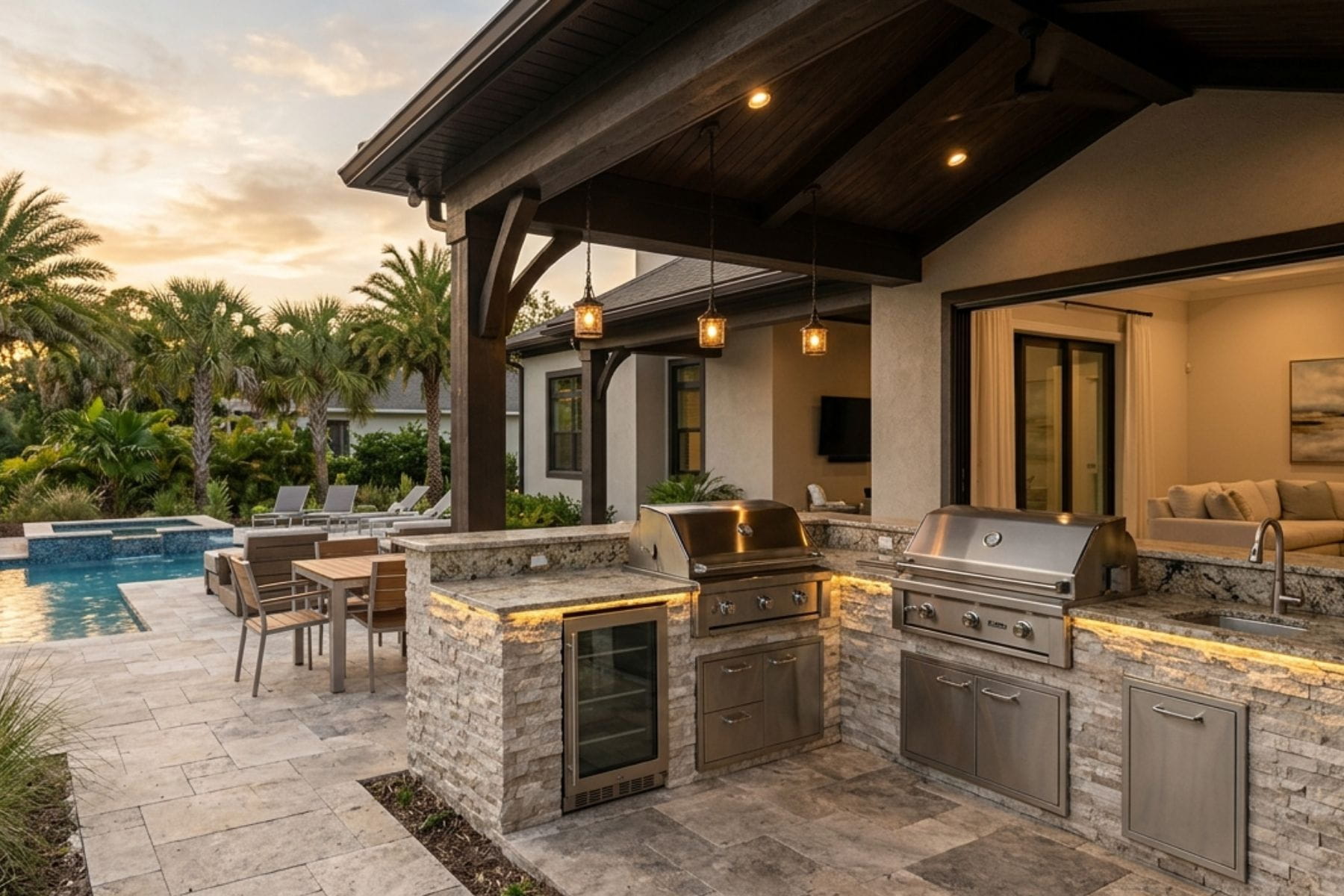
Jacksonville Outdoor Kitchens
Masonry Outdoor Kitchen Builders Serving the First Coast
Jacksonville’s outdoor season is essentially year-round. When you build a masonry outdoor kitchen — not a prefab kit, not pressure-treated lumber with a stucco coat, but actual concrete masonry construction with natural stone or tile countertops — you’re building something that will still be there, unchanged, in 30 years. That’s the fundamental case for masonry outdoor kitchens: they outlast everything else.
First Coast Masonry designs and builds outdoor kitchen structures throughout the Jacksonville area. We handle the masonry structure: the CMU block island framing, the countertop substrate, the veneer finish (stone, brick, tile, or stucco), the built-in grill surround, the integrated fireplace if the project includes one, and the paver floor. We coordinate with licensed plumbers and gas contractors for water and gas rough-ins.
How Long Do Masonry Outdoor Kitchens Last in Florida?
The outdoor kitchen market has two ends. On one end: aluminum stud framing with cement board sheathing, finished with thin stone veneer. These look good for a few years. On the other end: CMU block construction with full mortar joints, stone or tile countertops on a cement board and concrete substrate, and proper waterproofing details throughout.
First Coast Masonry builds the second type. Here’s why it matters in Jacksonville:
Humidity and Moisture — At 80% average relative humidity, everything on a First Coast property is perpetually damp. Organic framing materials (even pressure-treated lumber) absorb and release moisture cyclically, eventually leading to structural movement that cracks veneers and loosens tile. CMU block is dimensionally stable at any humidity level.
Hurricane Wind Events — A masonry outdoor kitchen that’s properly anchored with a concrete slab footing isn’t going anywhere in a tropical storm. Framed structures with lightweight finishes are more vulnerable to wind damage and flying debris impact.
Pest and Rot Resistance — Florida’s termite pressure is among the highest in the country. Masonry outdoor kitchens have no organic substrate for termite colonization. There’s nothing to rot.
Low Maintenance — A masonry outdoor kitchen needs periodic cleaning and countertop resealing. That’s essentially the full maintenance program. No staining, no repainting, no replacing rotted framing.
What We Build — Outdoor Kitchen Jacksonville
CMU Block Island Structures
The island is the foundation of every outdoor kitchen. We build them from 8-inch CMU block with filled and reinforced cells for structural integrity. The block structure provides:
- Open bays for appliance installation (grills, access doors, refrigerator cutouts, keg taps)
- Integrated utility chase space for gas lines, electrical conduit, and water supply
- A stable, level substrate for countertop installation
- The structural mass to support heavy natural stone or concrete countertops
Island configurations range from simple single-run layouts (grill at one end, counter space, storage below) to L-shaped and U-shaped layouts with multiple work zones, bar seating overhangs, and integrated dining areas.
Outdoor BBQ and Grill Surrounds
The grill surround is the centerpiece. We frame the grill opening to the specified appliance dimensions with appropriate clearances for heat dissipation — different grill brands and models have different clearance requirements, and these matter for both performance and safety.
We work with built-in grills from Weber, Twin Eagles, Delta Heat, Blaze, and other manufacturers. If you have a preferred brand, we’ll frame the cutout to match. Stainless steel drop-in grills in a masonry surround are effectively a permanent installation — they look intentional and integrated rather than afterthought.
Countertops for Jacksonville Outdoor Kitchens
Outdoor countertop selection matters more in Florida than in most climates. Options we install:
Natural Stone Countertops (Granite) — Granite is the gold standard for outdoor kitchen countertops in Florida. Dense, low-porosity, non-reactive to pool chemicals and cooking grease, and available in a range of colors that work outdoors. Requires sealing, but granite’s sealing interval is longer than most alternatives.
Porcelain Tile Countertops — Large-format porcelain tile set in a waterproofed substrate is an excellent outdoor option: non-porous, UV-stable, easy to clean, and significantly less expensive than slab granite. The tile and grout joints require appropriate grout selection (epoxy or modified grout) for outdoor wet exposure.
Concrete Countertops — Cast-in-place concrete countertops can be colored and finished to a range of aesthetics. They require sealing to resist staining and are prone to hairline cracking from thermal cycling — acceptable to most clients, unacceptable to some.
Poured Concrete Slab (Utility) — For utility sections and bar tops where aesthetics are secondary, a broom-finished concrete top provides a durable, low-cost surface.
Integrated Outdoor Fireplaces
The combination of an outdoor kitchen and an outdoor fireplace in a single unified structure — with the kitchen on one face and the fireplace on another, or with the fireplace as a distinct structure nearby — is the most popular outdoor living configuration on the First Coast.
We design and build these integrated structures as a single masonry project, which is more efficient than building them separately and produces better architectural cohesion. The fireplace and kitchen share a common footing, and the masonry finish materials tie the two structures together visually.
Design and Material Options
Exterior finish options for the island structure and surrounding elements:
Stone Veneer — Natural or cultured stone veneer is the most popular finish choice. Florida ledgestone, stacked stone, and ashlar patterns are all common. Stone veneer is set over a scratch coat on the block substrate.
Brick Veneer — Fired brick in a running bond pattern. Particularly appropriate when the outdoor kitchen is adjacent to a brick home facade — visual continuity matters.
Stucco Finish — A float or texture coat over the CMU block with a painted or sealed finish. Less material cost than stone or brick, but requires periodic maintenance as stucco cracks over time in Florida’s thermal environment.
Tile — Glazed or unglazed tile — appropriate only in covered applications, as direct weather exposure on tile faces creates maintenance problems over time.
Florida Outdoor Living — Why the First Coast Is Perfect for This Investment
Jacksonville averages 233 sunny days per year. The outdoor entertaining season is effectively year-round — even in July and August, a covered outdoor kitchen with a ceiling fan provides functional outdoor space for morning coffee and evening dinners when the day cools below 85 degrees.
The spring shoulder season (March through May) and fall shoulder season (October through December) are the best outdoor months on the First Coast: low humidity, temperatures in the 60s-70s, no active hurricane threats. An outdoor kitchen designed for these months — with an outdoor fireplace for the cooler evenings — gets used constantly.
From a real estate perspective, high-quality outdoor living improvements in Jacksonville’s market return well. A well-built masonry outdoor kitchen with an integrated fireplace is among the most permanent and visible improvements a First Coast property owner can make.
Jacksonville Outdoor Kitchen Contractors — Our Approach
A complete outdoor kitchen project involves multiple trades. First Coast Masonry coordinates the full scope:
Masonry Structure — Our direct scope: CMU framing, veneer finish, countertop installation, fireplace construction if included.
Gas Line Rough-In — A licensed gas contractor runs the supply line from the house meter to the outdoor kitchen location and installs the shutoff valve. We coordinate timing so the gas rough-in is in place before the island framing is complete.
Electrical — A licensed electrician runs conduit and circuits to the kitchen location for appliance outlets, lighting, and exhaust hood power if included. Again, coordination with framing timeline.
Plumbing — If the kitchen includes a sink, a licensed plumber runs supply and drain lines. Outdoor kitchens without sinks are common in Jacksonville — most clients choose to avoid the complexity and maintenance of an outdoor water supply.
Appliance Supply and Installation — We coordinate grill and appliance delivery with our construction schedule so they’re ready for drop-in when the masonry is complete.
Jacksonville Outdoor Kitchen Services — What We Build
1. Consultation and Design — We meet on-site, discuss your vision (appliances, layout, finish materials, fireplace inclusion), and produce a layout drawing for review before finalizing scope.
2. Site and Foundation — Outdoor kitchen structures are built on concrete slab or existing patio slab. If the existing slab isn’t adequate, we pour a new foundation pad as part of the project scope.
3. Coordination with Trades — Gas, electrical, and plumbing rough-in coordinated to be in place at the right construction phase.
4. CMU Framing — Block island structure built, with utility chases, appliance cutouts, and countertop substrate prepared.
5. Veneer and Finish Application — Stone, brick, tile, or stucco finish applied to island exterior.
6. Countertop Installation — Countertop waterproofing substrate prepared, countertop slab or tile set and grouted.
7. Appliance Drop-In — Built-in grill, access doors, refrigerator, and other appliances installed.
8. Final Details — Countertop sealing, final cleaning, walkthrough with client.
Service Area for Outdoor Kitchens
First Coast Masonry builds outdoor kitchens throughout Jacksonville and the First Coast:
- Jacksonville — all neighborhoods including Mandarin, San Marco, Ponte Vedra, Southside, Riverside/Avondale
- Jacksonville Beach, Atlantic Beach, Neptune Beach — beachside residential
- Ponte Vedra Beach and South Ponte Vedra
- Orange Park and Fleming Island — Clay County
- Fernandina Beach and Amelia Island
- St. Augustine and Nocatee — St. Johns County
- Yulee and Callahan — Nassau County
Frequently Asked Questions — Jacksonville Outdoor Kitchens
What materials are used for masonry outdoor kitchen islands?
First Coast Masonry builds outdoor kitchen island structures from CMU (concrete masonry unit) block — the same structural concrete block used in commercial construction. The block structure provides a dimensionally stable, rot-proof, termite-proof substrate. We then apply the desired exterior finish: natural or cultured stone veneer, brick, tile, or stucco. Countertops are granite slab, porcelain tile on a cement board substrate, or concrete.
How long does it take to build an outdoor kitchen?
A typical masonry outdoor kitchen takes two to four weeks from start to completion, depending on scope and coordinating trade availability. The CMU framing typically takes two to three days. Veneer application adds several more days. Countertop installation follows once the mortar cures. Gas and electrical rough-in must happen at specific phases. After the initial consultation, we’ll give you a realistic project timeline.
Can I include a gas grill in a masonry outdoor kitchen?
Yes. Gas grills are the most common built-in appliance in outdoor kitchens on the First Coast. We frame the grill opening to fit your chosen brand and model (or you can choose from our recommended list), and we coordinate with a licensed gas contractor for the gas line rough-in. The gas supply is run before the island framing closes up so the line is properly embedded.
Do masonry outdoor kitchens hold up in Florida’s weather?
Better than any alternative. CMU block construction is dimensionally stable in Florida’s humidity, resistant to termites and wood rot, and durable in high-wind events. The masonry finish materials — stone, brick, tile — are all outdoor-rated and proven in our climate. We apply appropriate waterproofing details throughout so moisture doesn’t accumulate in the island structure. Properly built masonry outdoor kitchens are genuinely permanent additions to a First Coast property.
Can you combine the outdoor kitchen with patio work?
Yes, and it’s usually the right approach. Integrating the outdoor kitchen build with paver patio installation — using the same crew and project schedule — produces better results and lower mobilization cost than doing them separately. We frequently combine outdoor kitchen construction with paver installation, retaining wall work, and outdoor fireplace construction into a single outdoor living project.
Request a Free Outdoor Kitchen Estimate
First Coast Masonry builds outdoor kitchens that match Jacksonville’s climate and your long-term expectations — CMU block framing, quality veneer finishes, and proper coordination with licensed gas and electrical trades.
Contact us to schedule a site visit and consultation. We’ll review your goals and deliver a free written estimate with complete scope.