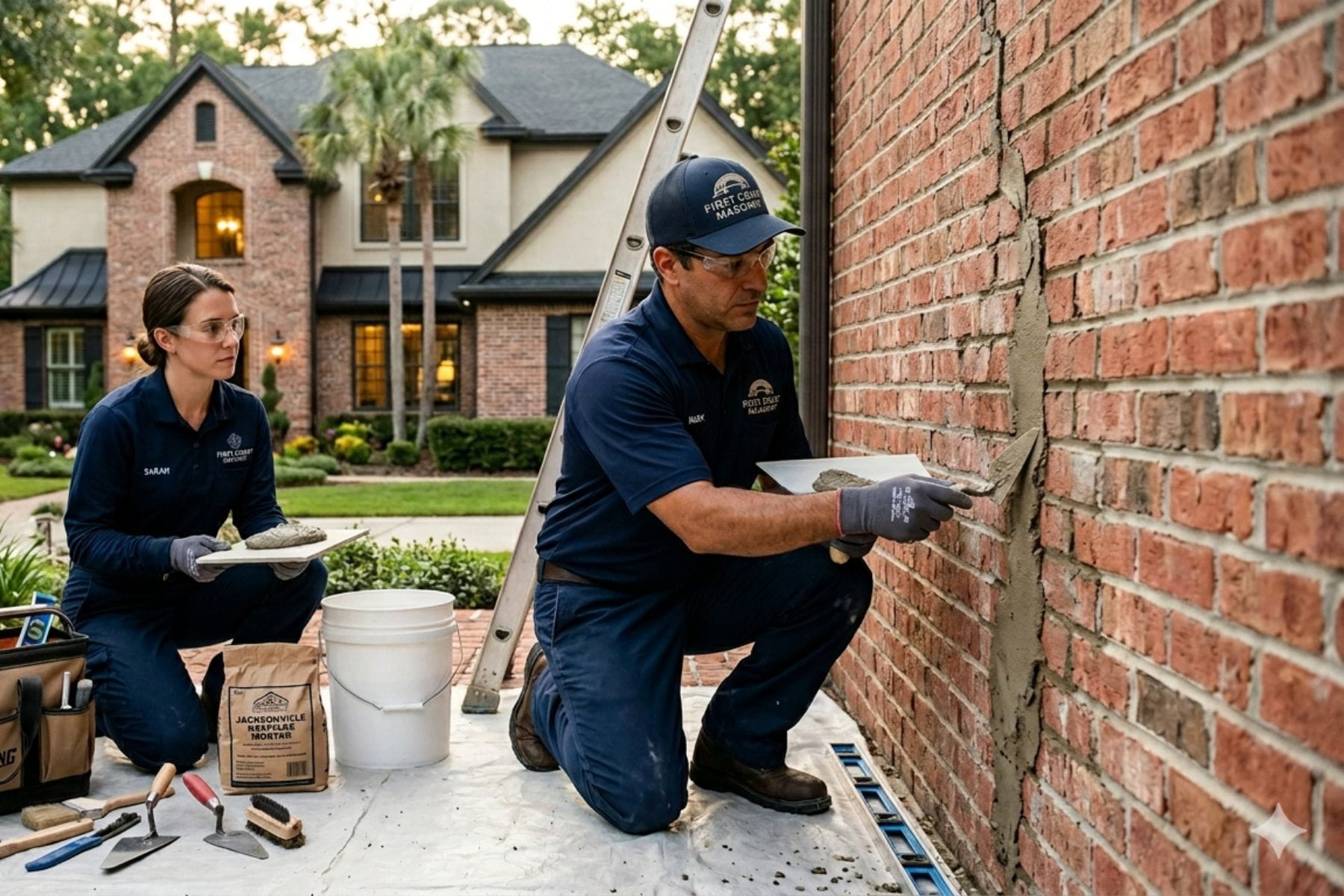
Jacksonville Masonry Repair
Jacksonville Masonry Repair Contractors — Fixing What Florida’s Climate Breaks
Florida is hard on masonry. The humidity, wind-driven rain, salt air, occasional freeze events, and sandy soil movement that define Northeast Florida’s environment create a predictable catalog of masonry deterioration that First Coast Masonry repairs every week. We’ve seen every failure mode — and more importantly, we know how to fix the underlying cause, not just the visible symptom.
Patching spalled brick without addressing the moisture that caused it wastes everyone’s time and money. Repointing mortar joints on a wall with failed flashing means the new mortar fails within a few seasons. Our repair process always starts with diagnosis before prescription.
What Are the Most Common Masonry Problems in Jacksonville?
Jacksonville’s climate and soil conditions produce a consistent set of masonry failure patterns:
Mortar Joint Deterioration
Mortar joints are the weakest link in any masonry assembly — intentionally so. Mortar is designed to be softer than the brick or block it joins, so that any movement or stress is expressed in the joint rather than in the more expensive masonry unit itself. Over time, exposure to rain, temperature cycles, and carbonation causes mortar to erode and eventually crumble.
In Jacksonville’s environment, the mortar deterioration cycle is accelerated by:
- Frequent wetting and drying cycles (52 inches of annual rainfall)
- Salt air exposure in coastal zones
- Occasional freeze events that expand water in open joint cracks
Eroded mortar joints allow water into the wall assembly, which accelerates deterioration of the brick, block, or stone behind the face. Early-stage mortar deterioration is cheap to fix (tuckpointing). Late-stage deterioration means the masonry unit itself has been compromised — significantly more expensive.
Spalling Brick
Spalling is the flaking or breaking off of the brick face, exposing the rougher interior of the brick unit. It happens when water penetrates the brick face and freezes — or, in Florida’s case, when the moisture cycling in the brick exceeds the face material’s cohesive strength.
Common causes of brick spalling in Jacksonville:
- Efflorescence buildup — Salt deposits from moisture migration that, when left unaddressed, crystallize behind the brick face and exert enough pressure to pop it off
- Over-application of high-pressure cleaning — Sandblasting and high-PSI pressure washing on older, softer brick removes the protective fire-hardened outer layer, exposing a more porous interior that spalls under subsequent moisture exposure
- Incompatible mortar repointing — Portland cement mortar that is harder than the brick creates stress concentrations that cause the brick face to pop rather than the mortar joint to yield
Spalled brick faces cannot be effectively patched with mortar — the cosmetic repair is obvious and short-lived. Spalled units should be replaced with matching brick whenever possible.
Storm Damage
Northeast Florida’s hurricane season runs June through November, and direct hurricane hits aren’t the only threat. Nor’easters, tropical storms, and severe summer squalls cause significant masonry damage each season:
- Wind-driven rain infiltration at mortar joints, window and door lintels, and parapet walls
- Flying debris impact — cracked or dislodged brick and block units, broken chimney pots and caps
- Chimney damage — The above-roofline chimney section is the most exposed masonry element on most residential buildings. Chimney cap dislodgment and chimney crown cracking are common post-storm damage items
We provide storm damage assessment and repair after significant weather events. If you’ve been through a hurricane or major storm and suspect masonry damage, early assessment prevents minor damage from compounding into serious structural problems.
Failed Lintels and Window/Door Headers
The lintel is the horizontal structural member (steel angle, stone, or reinforced brick) that spans the opening above a window or door and supports the masonry above. Steel lintels corrode in Florida’s moisture environment — the expanding rust forces the masonry above the opening to crack, sometimes dramatically.
Failed lintels are a common finding in Jacksonville-area masonry buildings from the 1950s through the 1980s. The repair requires removing masonry above the opening, replacing the lintel with a properly-sized and coated or stainless steel unit, and rebuilding the masonry above.
Efflorescence
Efflorescence is the white, chalky or crystalline deposit that appears on masonry surfaces. It forms when water-soluble salts in the masonry or mortar migrate to the surface with evaporating moisture and crystallize.
Efflorescence itself is primarily cosmetic, but it’s an indicator of active moisture movement through the wall — the underlying moisture problem is what needs to be addressed. Treatment involves removing the deposits (dilute acid wash or mechanical removal), identifying and eliminating the moisture source, and applying appropriate sealers once the wall is fully dry.
Foundation Settlement Cracks
Jacksonville’s sandy soil can shift under masonry structures, particularly where fill has been placed rather than undisturbed native soil. Settlement cracks in brick veneer, CMU walls, and masonry foundations follow characteristic stair-step patterns along mortar joints.
Minor settlement cracks can be repointed after confirming the movement has stabilized. Active settlement cracks — those that continue to grow — require addressing the foundation or soil condition before masonry repairs will hold.
Jacksonville Masonry Repair Services — Tuckpointing and Repointing
Tuckpointing and repointing are sometimes used interchangeably, though technically:
- Repointing is the process of removing deteriorated mortar from joints to a specified depth and packing in fresh mortar
- Tuckpointing in the traditional British sense involves a two-color mortar finish; in American practice, the terms are generally interchangeable for joint restoration
Either way, the process is:
-
Joint preparation — Deteriorated mortar is removed to a minimum depth of 3/4 inch (typically 3/4 to 1 inch) using a grinder, oscillating tool, or cold chisel. Improper depth leads to bond failure of the new mortar.
-
Mortar selection — Critical: the replacement mortar must be equal to or softer than the original mortar. Older pre-1920s masonry was often laid in natural hydraulic lime or low-Portland mortars. Repointing with modern Type S or Type N Portland cement mortar can be too rigid for the original brick and cause spalling. We assess the original mortar and match appropriately.
-
Joint packing — The cleaned joint is dampened to prevent rapid moisture loss from the new mortar, then packed in layers for deeper joints. Surface tooling to the specified joint profile follows.
-
Curing — The repointed wall is kept damp for the curing period to prevent shrinkage cracking.
Spalling Brick Repair Jacksonville
Spalling brick repair requires sourcing matching replacement brick — the most challenging aspect. Older Jacksonville brick structures were built with regional brick products that may no longer be manufactured. We source replacement units through regional brick dealers, salvage yards, and, when necessary, custom matching services.
When matching replacement brick is not available:
- Full wall repointing can mask unit variation by creating a more uniform overall appearance
- Stucco over existing brick is a period-appropriate repair on some older construction types (though it changes the facade character permanently)
- Acceptance with strategic placement — harvesting brick from inconspicuous areas (inside of chimney, back wall) to repair more visible areas
We discuss these options frankly with property owners before proceeding — there’s no universally correct answer, and the right approach depends on the building, budget, and intended outcome.
When to Hire a Jacksonville Masonry Contractor for Repairs vs. Replacement
The repair-versus-replace question comes up on every masonry assessment. General guidelines:
Repair is appropriate when:
- Mortar joint deterioration affects less than 25-30% of the wall area
- Spalling is localized to specific areas or specific brick units
- The underlying masonry structure is sound and dimensionally stable
- The failure mode (moisture source, settlement) has been identified and addressed or is addressable
Replacement or major reconstruction may be warranted when:
- More than 30-40% of brick units are damaged or the mortar system has failed systemically
- Structural movement is ongoing and the root cause cannot be economically addressed
- The masonry system is fundamentally incompatible with its current environment (wrong mortar type, inadequate drainage, failed flashing system that cannot be remediated)
We provide this assessment honestly. We don’t recommend major reconstruction when targeted repair will solve the problem, and we don’t recommend cosmetic repairs when the underlying problem will defeat them within a few seasons.
Our Masonry Repair Process
1. Diagnostic Assessment — We evaluate the masonry condition, identify failure modes, and trace moisture sources. We don’t diagnose off photographs — we inspect in person.
2. Written Scope of Work — Our estimate includes a written description of what needs repair, why, and how we’ll address it. No verbal estimates on repair work.
3. Moisture Source Remediation First — Where active moisture infiltration is the root cause, we address the source (flashing, drainage, crack sealing) before any cosmetic repairs.
4. Masonry Repair Execution — Tuckpointing, unit replacement, lintel repair, crown reconstruction, or whatever the specific scope requires.
5. Waterproofing and Sealing — After repairs are complete and mortar has cured, we apply appropriate sealers or water repellents where warranted.
6. Documentation — We document conditions found, work performed, and any ongoing monitoring items the property owner should watch. This is especially useful for sellers and property managers.
First Coast Service Area for Masonry Repair
First Coast Masonry repairs masonry throughout the Jacksonville metro area and surrounding First Coast counties. We work on historic commercial buildings in Springfield and Downtown Jacksonville, brick residential homes in Arlington, Riverside, and Avondale, and coastal properties from Neptune Beach to Amelia Island.
Our full service area:
- All of Duval County and Jacksonville proper
- Clay County — Orange Park, Fleming Island, Green Cove Springs
- Nassau County — Fernandina Beach, Yulee, Callahan
- St. Johns County — St. Augustine, Ponte Vedra, Nocatee
- Baker County — Macclenny (limited availability)
Frequently Asked Questions — Jacksonville Masonry Repair
What is tuckpointing and when does it need to be done?
Tuckpointing (or repointing) is the process of removing deteriorated mortar from masonry joints and replacing it with fresh mortar. It’s needed when mortar joints erode to a depth where water can penetrate — typically when you can fit a pencil or screwdriver into the joint more than 1/4 inch. In Jacksonville’s climate, older masonry should be inspected every 10-15 years. Coastal properties, due to salt air exposure, may need repointing on a shorter cycle.
How do I know if my masonry needs repair?
Warning signs include: white staining on the masonry face (efflorescence), crumbling or recessed mortar joints, brick faces that are flaking or chipping, cracks following mortar joint patterns (stair-step cracks), moisture staining inside the building at exterior masonry walls, or visible cracks above windows and doors. Any of these warrants a professional assessment.
Does Florida’s weather cause masonry damage?
Yes, in predictable ways. Wind-driven rain infiltrates deteriorated mortar joints and failed flashing. Salt air in coastal zones accelerates mortar deterioration. Occasional freeze events expand water in existing cracks. Sandy soil movement creates settlement cracking. Florida masonry requires more active maintenance than masonry in drier climates. The good news: when problems are caught early, repair is much less expensive than reconstruction.
How long does masonry repair take?
It depends entirely on the scope. A chimney crown replacement is a one-day job. Tuckpointing a full exterior on a two-story commercial building takes several weeks. Spalling brick replacement on a residential chimney takes one to two days. We’ll give you a realistic schedule with your written estimate.
Do you do emergency storm damage repair?
Yes. After significant storm events — tropical storms, hurricanes, severe thunderstorms — we respond to storm damage assessment requests as quickly as our schedule allows. Priority is given to situations where structural damage poses immediate risk (chimney collapse, large wall cracks, major moisture infiltration). Contact us immediately after a storm if you suspect significant damage.
Request a Free Masonry Repair Assessment
Masonry problems don’t improve with time — they compound. What costs a few hundred dollars to fix today becomes thousands if the moisture infiltration continues for another few seasons. First Coast Masonry provides honest assessments, clear written scopes, and repairs built to last.
Contact us to schedule a free written estimate. We visit the property, document conditions, and explain exactly what we recommend and why.